Showing posts with label Craig Saunders. Show all posts

Tuesday, May 1, 2012

Read the End First!

Last December on a brisk, overcast Sunday afternoon, I moseyed into my Writing Room (I was penning fresh pages on my beloved lap desk in the living room at the time while No Country for Old Men played on the flatty) to find a Facebook IM waiting from Suzanne Robb.  Suzanne and fellow editor Adrian Chamberlin were compiling a new anthology for Wicked East Press, a brilliant themed collection that would examine the end of the world as imagined through different apocalyptic scenarios, each tale tied to a specific time zone and place.  At the very Eleventh Hour, an author who had committed to the book left the editors high and dry -- did I have anything in my idea catalog or file cabinets full of first draft manuscripts set in Islamabad at midnight during the end of the world?  If so, would I be interested in sending it along?

I promised I'd get right back to Suzanne just as soon as I ran an eye over my manifest of completed stories.  A quick scan showed that I hadn't written anything appropriate, nor did I have an idea sitting in my card catalog of unwritten projects that would work -- the guidelines were that specific.  However, they were also that fantastic and I love a literary challenge so, within an hour, the germ of an idea whispered in my ear.  I didn't have a lot of time -- the book was due to be turned into the publisher in less than a week.  I committed, knowing some of the bylines already associated with Read the End First, fine scribes like Craig R. Saunders, whose contribution "Red" I'd read first the previous summer during a for-fun manuscript exchange.  Other notables included John McCuaig, Patrick D'Orazio, Ms. Robb, David Dunwoody, Dave Jeffery, Emma Ennis, the delightful Darren Gallagher, and the Sniders, Henry and Hollie, great friends and talented writers alike (Hollie has become one of my favorite contemporaries, her tales layered and luscious and always such a treat).  One day later, I had the scope of what I wanted to say in my story, "The Midnight Moon," about a young professional man living in Islamabad who laments lost dreams on the night that a shift in the orbit of Earth's moon leads the lone satellite too close to its primary planet, Midnight +5 GST.  I wrote the story quickly, fired off my edited draft, and closed that gap in the anthology's twenty-four hour story cycle.  End was just released, and the book -- blurbed and foreworded by a stellar lineup that includes Jonathan Mayberry, Graham Masterton, Joe McKinney, Marianne Halbert, and Joe Schreiber -- not only meets the build-up in anticipation, but mightily exceeds it.  A page-turner from cover to cover, I was lucky to get many of my fellow authors (and Gary McCluskey, who created End's gorgeous cover art) to share the back stories behind their excellent contributions to the end of the world.

DA Chaney on "Elemental Bonds": The idea for “Elemental Bonds” came to me as an ‘anti-love’ story premise. Instead of portraying the main characters in a loving and deeply profound relationship, I wanted to explore the idea of revealing people who weren’t even fond of each other. Folks who were opposites thrown together in life, but more importantly, in death, as well. I had to then deposit the characters into my desired time zone. In looking up ship tours in the Antarctic, there were some hidden gems. Not only were there vacation packages for voyages through the area, but also an ecological research facility called “Palmer Station” with photo’s, descriptions, history, weather conditions, and even a live outdoor video broadcast with a fifteen second relapse feed!  I took some liberties, especially with a fictitious cruise line route that would place my characters close enough to where I needed them to be and with a hypothesized layout for Palmer Station’s internal structure but otherwise, that’s how the story came together. The title comes from two places. It indicates the creature type highlighted in the story and the emotional bond between my characters. It is also a nod to a quest-line from the World of Warcraft. It was truly a delight to write my piece for ‘Read the End First’ and I’m very glad I was able to be a part of a collection of stories brought together for the purpose of proposing the final moments of Earth.

Adrian Chamberlin on "Resisting RagnarÖk":  "The Sons of Loki took the name of the Gods in vain, used us as justification for their murderous rage. They wish to see the world burn. And burn it will...they have invoked the slander-bearer of the gods, the Father of Lies, for their own purpose. The world shall tremble."

"One of the joys of participating in this anthology was being allowed to choose your own apocalypse. I asked Suzanne for a timeline that crossed Iceland because it's a country that fascinates me. I originally started posting Icelandic Proverbs as a weekly Facebook status updates for a giggle: "Pissing in your shoes won't keep your feet warm for long," and "cultures live and die, but the cheese is immortal" kept me amused, but then reading more of the country sparked a love affair with a land I've never visited, and spurred a desire to write a story using Iceland as a setting. Coupled with my interest in Norse mythology, Ragnarok was the obvious apocalypse. But a futuristic one? THAT was the challenge, so the first thing to do was to check out when the next total eclipse was due: that would be the wolf swallowing the sun. I liked the idea of a religious terrorist sect that plotted destruction in the name of a Norse god, and stealing a weapon that took its name from the World Serpent, so the metaphorical becomes literal. Now I want to visit - I have until 2029 to save before Iceland meets the doom I foretold. Should be enough time to save for about four beers in a Reykjavik bar, I think..." 

Darren Gallagher on "The Only Place to Die": "When I was asked to write a story for "Read The End First" and only had a few time zones to choose from, I agreed even though I had no idea what I was going to write about. Then I remembered an idea that I'd gotten a few weeks before. It was about a man sitting on a boat in the middle of the sea at night, reminiscing about a lost love. So with the -11 slot free, it was the perfect setting for my story, "The Only Place To Die." It was a story I wanted to put a lot of emotion, atmosphere, and descriptive writing into. And with the backdrop of the Aurora while comets rain down on the earth, I think I managed to do just that. I hope everyone enjoys reading it as much as I enjoyed writing it."

Suzanne Robb on "The Barrier Between Here and There": "The idea for this story came to me many years ago when I was in an Old World Pre-History class at University.  My professor talked about this mysterious wall that at the time was a point of tension because of land rights.  No one could prove how old it was or how it was made with such exact measurements.  There were also bones found of what archaeologists thought might be some sort of "rat alien" proving there were settlers there prior to the Maori. I imagined a whole race of gruesome creatures with strange bones and wondered what if there had been a war between good and evil and at the end a barrier was built in order to keep them at bay.  What if the barrier broke?"

Henry Snider on "Stormfront": "As I was drawing a blank as to what to write, I asked Suzanne to give me the hardest time zone to place in the hopes the location would provide the story.  With only a small cluster of islands to work with and a local population rivaling that of the typical Walmart on any given day, I ended up with "Stormfront."  Early on, while writing the story, I had trouble because of constant noise right outside my window.  Then, two sentences later, my problem became the focus of the story.  Funny how things work out that way."

R.B. Payne on "Kaupe, God of the Cannibal Dog-Men": "While in Hawaii, I became aware of a legend about an ancient god and his army of dog-men that fought many battles and nearly conquered all of the Hawaiian islands. In the end, he was defeated but the legend had it that he still lived in the clouds above O'ahu and was waiting to return. As I sat and looked across the white sands of Waikiki Beach, I wondered... what if Kaupe returned today amidst the tourists, hotels, and shopping arcades? That was the genesis of the story and I took it to an apocalyptic level where there were few human survivors left and no communication with the 'outside' world. It was an entertaining story to write and I hope the readers of Read the End First really enjoy it."

Rebecca Snow on "Best Intentions": "Aside from knowing that Garfield always packed Nermal in a shipping crate and sent him to Abu Dhabi, I knew nothing about the area before being asked to write a story for the +4 time zone.  With the help of friends who had been there and lots of research, I was able to piece together a reality the characters could inhabit.  I had a lot of different ideas for an apocalypse, but I was limited in my knowledge of the people.  I restricted the story to mostly public spaces and something we all have... atmosphere."

Craig Saunders on "Red": “I wrote 'Red' in one sitting (not including the barbaric edits!) with the barest of research. I hate research, and when the topic of a time zone came up I nabbed Japan early on, because I lived there for five years. Any excuse to avoid research! Shinigami (Death) is a central feature of the story, as is a mysterious disease. I won't go into too much detail, but I loved setting what was basically a show-down in a wasted Japan...it's old school Samurai meets the apocalypse, I guess you could say!” 

Patrick D'Orazio on "What Rough Beast?": "When I received my copy of the book I found myself amused at the commentary that Joe McKinney provided, because he uses the same poem in his analysis as I did to craft the name of my story, "What Rough Beast?"  He also talks about how the old tales of the apocalypse would have morphed into new tales, with new beasts, had they been written today.  Well my tale actually takes a step back and is far from being 'ripped from today's headlines' it actually revisits that baffling book of the bible, Revelation.  I chose Bethlehem, and more specifically, the Church of the Nativity, which is built over the place where it is believed that Jesus was born.  So why wouldn't the birthplace of Christianity play a part in the demise of the world?  I thought it made sense, at least within the twisted passageways of my mind."

Stephen A. North on "Like a Man": "Had nothing, no idea at all, until Suzanne told me my time zone. I thought Rio would make an interesting location, and it would have weather similar to what I'm familiar with (Florida). I'd also been curious about the Hollow Earth Theory, and have an interest in the various species of humanity. While reading up about Rio I found out that they have a problem with exploding manhole covers. All of those things came together in my brain, and next thing I knew, Neanderthals were back."

Patrick Shand on "That Guy Who Writes Zombie Novels": "That Guy Who Writes Zombie Novels" is my love song to small presses. I primarily write comic books and young adult novels, so 2011 was an odd year for me - I spent a good portion of it writing and submitting creepy tales to small press horror anthologies. I thought it fitting that my final tale of the year would be very much about indie publishers and the mindset of a writer trying to make lasting statements through short stories. There's a bunch of me in R. T. Spike, but he's also an amalgamation of a bunch of wonderful authors and editors who have worked on anthologies with me. On the horror side of things, I wanted to tell the tale of the least fun zombie apocalypse ever. See, the recent zombie craze has had legions of people imagining the epic kills they'd score if the dead went all Kirkman - but what if the zombies still had all of their smarts, emotions, and memories... but just couldn't control their urges? That, to me, is sad as hell. I hope "That Guy Who Writes Zombie Novels" makes you all sorts of depressed, while also tickling your funny bone. I like my apocalypse with a heavy heaping of chuckles, and I hope R. T. Spike and I delivered.

Dave B. Jeffery on "Ice Rage": “When I was first approached to contribute to the anthology I found myself stumped for a storyline. Having just finished several zombie stories for other anthologies I did not want to do another post-apocalyptic piece using this angle. I mulled it over and, if I'm honest, came close to turning the offer down as I didn't feel I could bring anything fresh to the table. As such, the idea for “Ice Rage” came by complete chance. I watched John Carpenter's The Thing and Niles' 30 Days of Night within the same week. I made a decision that a horror story with the savagery of 30 Days of Night and the human dynamics of The Thing would be something I'd be interested in writing. Given that both stories were based in frigid climates, I began to consider this within the context of the anthology and came up with an apocalypse based on another ice age. That damn 30 Days of Night movie kept at me to the point where I wanted to do an homage. Vampires were out, of course, so I needed an alternative supernatural creature; one that could survive -79 temperatures. Well, the Yeti came to mind almost immediately and then the story just flowed! A bunch of angry Yeties and Ice Rage was rolling. So, in short, my contribution is 30 Days of Night -- with Yeties!

John McCuaig on "EMP": "Sometimes I feel as though we take too much for granted, even as I type this reply do I praise the wonder of electricity and the power of the internet as I stab away at the keyboard? Every time I open a newspaper I read about a raft of new inventions and ideas designed to improve our lifestyle. Do you ever wonder if we are pushing things too fast and too hard? What would happen if one day all technology was ripped away, how would we then react? Could the majority of us even survive without our creature comforts never mind the basics of heat and light? E.M.P is a story of the ultimate experiment gone wrong, mankind is thrown back into the stone age, and like clockwork, every few hours a powerful wave returns to remind us of our frailty."

Brooke and Scott Fabian on "Not With a Bang": "In late 2011 the news cycle was dominated by the story of an Ohio man who opened the cages of his private zoo before killing himself.  Sadly, the horrific task of catching, and mostly dispatching, escaped exotic animals was inherited by the local authorities.  Images of dead lions and tigers lined up in neat rows ricocheted from one media outlet to the next. The whole event had a kind of "end of days" quality that both entranced and repelled us. We decided right then that our story would take place at the Anchorage Zoo.  There was one problem -- the threat of escaped animals is not particularly horrifying when the world is dying.  Still, those images of animal carcasses where genuinely disturbing and curiously...moving.  We agreed to write a sweet story about the end of the world. Like Life is Beautiful, but in a zoo. It is our hope that Not With a Bang is toned down apocalypse story that any reader can relate to." 

Emma Ennis on "Hammered and Nail": “When the good Ms. Robb emailed me asking for my chosen timezone for Read the End First, I think I was in the midst of a particularly bad bout of homesickness. This, I imagine, was the main reason that prompted me to begin my annihilation of the world in Norway - one simply cannot initiate the apocalypse from one's beloved home country... well, all excepting Mr. Wayne Goodchild of course. Henceforth, 'Hammered and Nail' poured its foundations in GMT+1. For some time I'd had a single word scribbled on a page of one of my many notebooks, surrounded by a lot of blinding white space - 'tetanus.' It had been on my poor jaded mind for a long time to cook up a tale as horrible as haggis, with tetanus at its core. This was primarily due to a grotesque picture I had come across on the web, of the state of 'opisthotonos' induced by the disease. When Suzanne mentioned the premise of Read the End First there was no doubt in my mind as to how the world would end: Tetanus. It was that simple. All it took was one Lars Jensen, a rusty nail, and a fear of needles, and the end was nigh. Hey, don't look at me, blame the Norwegians!

Wayne Goodchild on "The Heavens Reflect Our Labors": "I'm sure many people secretly (and not so secretly) wish for the destruction of their hometown. With Read the End First, Suzanne Robb finally gave me a legitimate chance to utterly destroy Scunthorpe in 'The Heavens Reflect Our Labors'. The title comes from an old motto relating to the vast steel works that dominate the town, and how the glow from the various furnaces would light up the night sky. The steel industry and subsequently the works are slowly dying, so there is less instance of this sort of thing happening nowadays, and I wondered what it might be like if the world itself realized this and staged a different type of 'industrial revolution'. I'm really interested in how people typically despise their place of birth, even if it's nowhere near as bad as they make it out to be, and decided to put all those feelings into one man - Dave Moore, the "hero" of the story. Is he our one hope for salvation, or destined to be consumed by the new world he finds himself in? Who knows! Well, you will once you've read the story. OR WILL YOU?"

Sean M. Thompson on ""The Time of the Shaman": "My story was merely an attempt to find some kind of common theme among Siberia, and the other regions [in that time zone]. One of the things I discovered was that shamanism, if you went back far enough, could be found in most of the regions. So, I went from there.  Likewise, I enjoy writing about the soul. I'm not sure if I even believe in the concept of a soul, as an agnostic/hedonist/believer in animism/paganism, but it sure is fun to picture groups of silent masked people in robes with all sorts of translucent ghosts flying around them."

Hollie Johani-Snider on "Blood and Soil": "Blood and Soil" came to me when I was researching for another story idea involving World War II, Zyklon B, Nazis and the New York Museum of Natural History. I know, not your typical story combination. And yes, I'm still working on that one too. Anyway, the story title of "Blood and Soil" came about from this research and is an actual German ideology focusing on an ethnicity based on two factors -- descent of people (Blood) and their homeland (Soil).  The real theory celebrates the relationship people and the land they live on, placing more value on rural than urban living. Naturally, I had to twist this. I'd been reading a lot on the expeditions to Mars and the colonization theories, and found out Jupiter's moon, Titan, could be a possible place for human colonization. So, I figured these Germans are a fanatical branch of the Nazis who want to cleanse the Earth of anyone who doesn't celebrate the "back to basics" way of living through an arranged mining accident, then take those they valued off to a secret colony.  People are chosen by these fanatics for their skill set in forming a new, superior race, not on their ethnic background. And poor Ethan has the nasty job of setting these wheels in motion. As for why Yellowknife? Why not? It's relatively remote, has a great source to introduce a toxin, and already has some Superfund issues."

And the talented Gary McMahon, on his beautiful cover art: "I have to admit when Suzanne (that's Ms. Robb to you people) said she needed a cover for a ' for the love anthology', I thought she meant porn so I said 'yes' right away.  Heh, just kidding, let me start over. Apocalyptic fiction (pre- post- whatever) is probably my favorite genre of fiction. I Am Legend, The Stand, even the War of the Worlds are all favorites of mine. The concept behind Read the End First couldn't be any cooler for someone like me to illustrate. Suzanne gave me a few suggestions of what she and co-editor Adrian Chamberlin were looking for. Mostly they wanted to get the point across that these stories would run the gamut for end of the world fiction and didn't want to show a single specific world's ending. The idea was to do this fairly quickly before I went in for hernia surgery. That didn't happen so much of it was finished in a Vicodin haze. Hopefully the viewer first sees the bright colors of the Earth breaking apart. From there my plan was that the viewer would (looking left to right) see the moon crashing into the Earth and see the procession of midnight clocks all swirling down to the 'end of time-end of life' black hole. Originally it was to have Lovecraftian tentacles writhing out of it. That looked too busy and too specific so it became an Evil Death Skull. Finally, it needed a title that was bold but again, not too busy. The blocky white type seemed to work and the touch of destruction in End was enough to fit the mood of the cover. Oh, and it's all digital, all Photoshop. That's the end of the art lesson for today."

Wednesday, August 17, 2011

From the Bookshelf: Review of SCARECROW AND THE MADNESS by Craig Saunders and Robert Essig


Ask any number of my creative friends, most recently those fine folk in my Wednesday Night Writers Group, and they'll tell you that I've been known to emote over how much I love discovering exciting new voices in literature.  Toward the end of a ten-year run working for a trio of magazines put out by a now-defunct publishing behemoth that gasped its final breath in 2010, in and amongst writing original short fiction, feature interviews, Web and DVD reports, I was also assigned the occasional book to review.  The best of those books still hold places of honor on the limited shelf space in my beloved Writing Room.

So when out of the blue I was asked to review Scarecrow and the Madness by Craig Saunders and Robert Essig, a forthcoming release from Blood Bound Books, I was more than intrigued.  I'd already become a fan of Essig, a cryptic and ominous presence out there in the realm of such fantastic presses as The Twisted Library and Pill Hill Press, and whose work mine had shared space with between the covers of numerous anthologies, and I seriously liked Saunders from the jaunty everyman vibe he projected from posts in various publisher forums I subscribe to.  Also, Saunders and I are set to appear in the Library's forthcoming Fearology 2: Beware All Creatures Great and Small, me with "The Tora Bora Horror", he with the most intriguing title in the entire ToC, "The Monkey's Sandwich".  So I agreed.  Cross-eyed late one Sunday afternoon after a long day of writing, I opened the .pdf ARC.  An hour later, it struck me that I hadn't been able to put the thing down.  Exciting new voices in literature?  Be careful what you wish for!

Scarecrow and the Madness is a wonderful hybrid approach to publishing, the print version of one of those Creature Double-Features I recall so fondly from my youth: two authors with completely different novellas, the only common threads being an absence of supernatural evil in both story lines (lending an even greater dose of the sinister because the malevolence is human), tales told in brisk day-to-day format, and complimentary muscular writing styles.

In Scarecrow, Saunders' opening salvo, we meet Margaret and Bernard Rochette, your typical older couple living on a remote farm in the marshy lowlands of eastern England known as The Fenlands.  Madge and Bernie have reached the banal stage of their relationship that comes from a long marriage and the understanding couples share after decades of being together.  She keeps their world in orbit and nags Bernie about his health and not drinking in excess when he joins his mates in town at the pub.  Bernie fibs about his drinking, even while sensing it's probably impossible to pull one over on his hawk-eyed wife.  While much of the passion appears to have evaporated from their marriage, it's clear how close the Rochettes still are, linked by structure and a genuine love for one another, even if it's rarely professed.  That structure and love will be sorely tested on the morning a bearded policeman shows up at their front door while Madge fries bacon and Bernie lollygags in the can, warning the couple to keep their doors locked and their eyes open, for a band of itinerant gypsies has just made camp in a neighbor's field.

Saunders' pace -- as both Madge and Bernie run afoul of the malevolent Mulrone Family -- never slows.  Nor does the author's sly ability to do that which is all-important in fiction: making us care about his characters.  What happens to Madge and Bernie is equally shocking in terms of the presentation and how deeply it affects the reader.  I was forty pages in before remembering I had dinner in the oven, or that I was sitting in the big, comfortable blue chair of my home office, not racing in a breathless panic around the Fens or the Rochette's ancient Georgian farmhouse as part of Saunders' engaging nightmare trip.  I rushed back first thing the following morning, desperate to know the ending, which is a bitter though brilliant surprise.

Recently, I had the opportunity to sit down with Saunders and discuss his novella and greater body of work.


What's the behind-the-scenes story of SCARECROW?
Scarecrow was based purely on a conversation I had with a friend about gypsies...the police came to her house and warned her to lock up, because thefts increased dramatically when the gypsies were in town.  I thought about how racism is viewed in our little corner of the world...but then I thought, what if there was a reason for this? What if, like any other ethnic group, there were bad elements...downright evil elements...the Mulrone family came from that simple idea.  I will write more Mulrone family stories.  In fact, I'm writing one next!  I find people to be the most frightening of all.  Pirates, in particular.  And clowns, too.  Anyone that dresses funny.

Take us into your writing space.  What's it like?  What's your process?
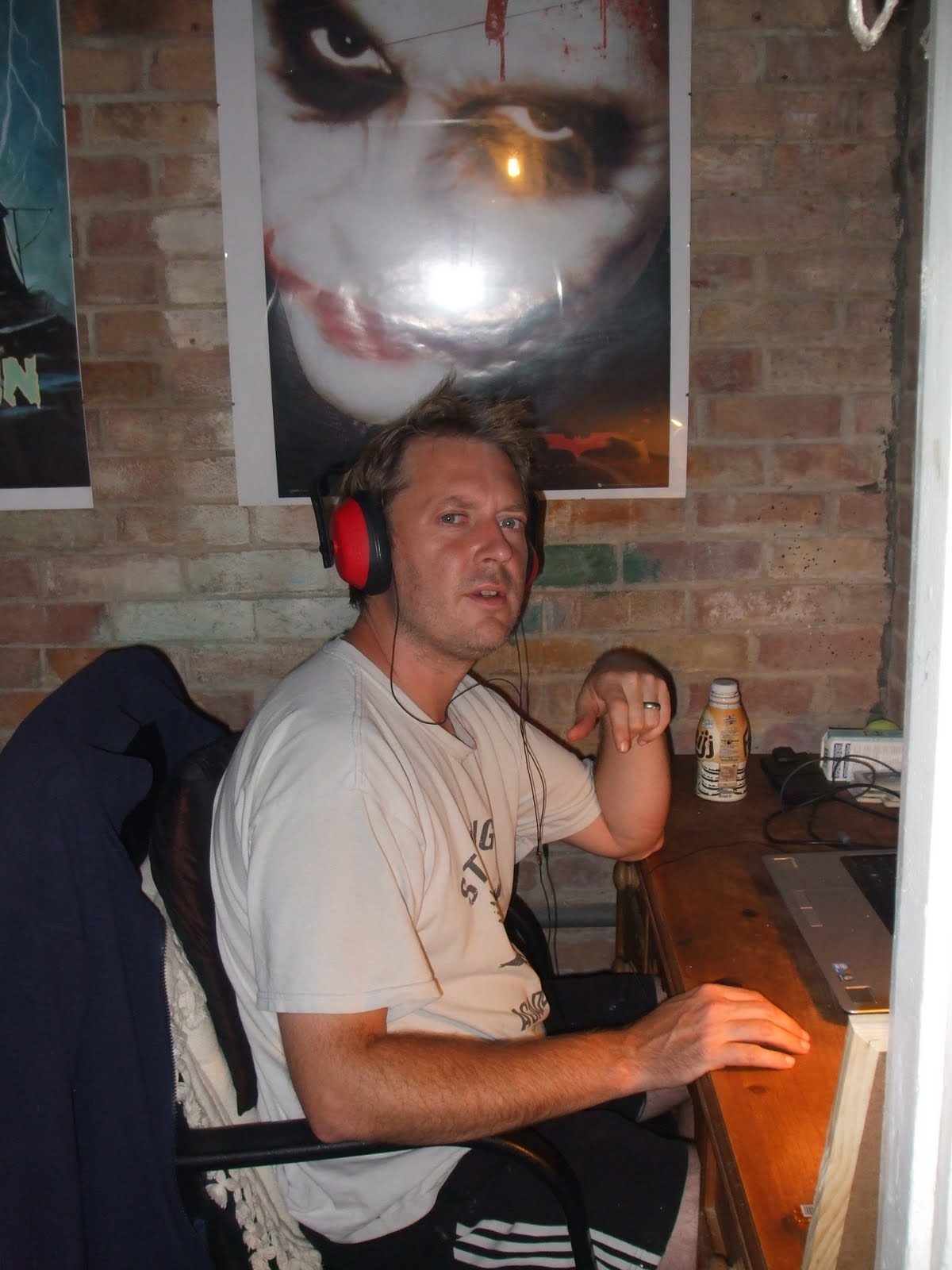
I write in a tiny shed with slugs in it.  I have my posters on the walls -- one a reprint of the poster for Frankenstein (the original, in German, featuring Boris Karloff), one with a blowup of Heath Ledger's Joker, and a promo poster for Stephen King's mini-series, The Stand.  I write on an old computer on a dressing table that was once my nan's, with a broken office chair that's really uncomfortable.  The tumble dryer is behind me, usually providing white noise.  I listen to loud music on headphones, never write with money in my pocket, and always wear shoes.  Because once you've trodden on a slug barefoot, you never want to do it again.

I don't really have a process.  I'm a little OCD, among many other foibles that I have.  I don't write a plan, which is probably the only hard and fast rule I follow.  I've written long hand, on the computer, only done one draft on some stories, ten or twenty of others.  The longest I spent on a story is two years, but usually I write novels fast.  I don't spend more than one day on the first draft of a short story, and rarely more than a month on the first draft of a novel.  I find that writing fast puts me under much needed pressure, because otherwise I'm ridiculously lazy.  If I take time off, it usually turns into months, but then at the pace I write I find I need a while to recuperate afterward, usually playing a game.  I like Fallout.  A lot.

What truly scares you?  And inspires you?
Like I said before, I find people terrifying.  They have a capacity for evil unknown in nature.  A dog might turn on its owner and bite, but it will never keep someone in captivity for years in a basement, or torture someone, or rob and murder and maim.  People are truly frightening...that's why I live in my shed!

That said, nice people inspire me.  I love nice people.  But with regard to my stories, my county, Norfolk, is often the inspiration.  That, and the places I visit.  I'm usually more inspired by houses, dark cemeteries, abandoned seaside resorts.  Places are generally central to my novels and the Fens, in particular, where Scarecrow is set, is one of my least favourite places.  It has an eerie feel to it.  Flat, unending landscape with few trees....feels like the kind of place where people get lost and go missing forever.  Maybe get eaten by a pumpkin.  That doesn't happen in Scarecrow.  May happen in real life, mind...


Share with us your ten favorite words.  Are there any least favorite?
Offensive words, though I use them all the time in my writing, are my least favourite when applied with malice, though even the harshest words can be funny if they're used in the right way.  I figure if you're going to go for an insult, though, go large.  My ten favourite words, in no particular order, are:

Gusset
Ramble
Reminisce
Sepulchre
Arse
Chuffed
Love
Cemetery
Forlorn
Dickhead.  That one really makes me laugh, for some reason.

You're not a writer but sell insurance.  Then you wake up and realize the actuarial tables were only a bad dream.  Breathe a sigh of relief -- you're a writer again, working with words and mining the vast reaches of your imagination.  What does being a writer mean to Craig Saunders?
It's a good question.  The answer is...I don't know.  The longer answer, perhaps more interesting, is as follows: I think two things saved me from oblivion after a misspent youth and early manhood -- writing, and my wife.  I don't think I could exist without either.  I love writing.  There's no greater feeling than when I write a chapter or a short and sit back at the end of it, having knocked it out of the park.  I get such a buzz when the muse is in the room, whispering in my ear what to write.  Sometimes, it's almost automatic.  I read things back and forget writing them.  If I think, hey, that's good, I keep it.  I've been writing seriously now for about four or five years, and loving every minute of it.  I couldn't do anything else anymore.  Kind of like if you've seen the light and eat smoked bacon after the plain stuff.  I love bacon.  I love writing almost as much.  Oh, and my wife -- nearly forgot!


And now, on to The Madness.

Have you ever sat down with someone and thought...that person seated way too close is stark-raving crazy?  Imagine you're driving home at a desperate clip in the middle of a wicked blizzard, likely facing certain death...until you take a wrong turn, crash your car, and land yourself at the table of a reluctant benefactor, snowed in for the long haul, sitting across from a very tall, very strong, and very dangerous man who isn't quite right in the head.  That's the unsettling premise to Robert Essig's claustrophobic page-turner, which weighs in at three times the length of its predecessor.

The Madness opens with bank manager Tony racing through the snowstorm and looming darkness, desperate to get home.  It soon becomes clear he'll never make it, so Tony opts to crash in (literally!) on the home of the Ritter Family -- wife Sue, son Phillip, and towering, brooding auto mechanic Dan.  Dan makes it clear he's none-too-pleased to have a stranger in the house, especially given that dangerous family affliction known as the 'brain-tickle', which manifests itself whenever Dan drinks.  And it certainly doesn't help that Tony's got a streak of madness in his past...and is hearing voices of his own. As the white-noise whine of insanity builds inside the snowbound house, so does the violence in ever-thickening ripples that left me switching allegiences and waving a finger at Essig for being such a naughty boy -- and skilled storyteller!

It was my delight to also speak with Robert Essig, who shared his insight into the making of The Madness.


What's the back story behind the story?  How did THE MADNESS unfold?
Several years ago I was listening to a talk-radio host who was discussing a terrible storm in Colorado where several small communities were snowed in. The host shared his own story of a similar situation and how unprepared his neighbors were. That was an interesting topic for a guy who has lived his whole life in San Diego and has rarely seen snow. I began wondering what would happen if someone became stranded in a snowstorm and was forced to seek the kindness of strangers in a mountainous region without neighbors and the disastrous consequences of broken trust between both parties.

Your byline is everywhere -- tell us where you've been, and where we can look for you in the future.
I’ve been working my way up the small press ladder, so to speak, by getting my short fiction published in a variety of anthologies and magazines. My first sell was to Tales of the Talisman, and I would have to say that I am most proud of the story I sold to Necrotic Tissue (the magazine is now defunct unfortunately). Not necessarily because of the story itself, but due to how much I liked that particular zine (it is a particularly nasty tale, though). I am also quite proud of the two anthologies I have edited -- Through the Eyes of the Undead and Malicious Deviance.

What lies in the immediate future is the release of my debut novel People of the Ethereal Realm, forthcoming from Twisted Library Press, along with a sprinkling of short stories such as “Skeletons in the Basement” in Dead Souls (Post Mortem Press), and “Contents of a Canvas Bag” in Look What I Found (NorGus Press).

You write primarily Horror. Share with us your history with Horror, what you love about it, what you think needs to be changed, re-imagined, staked.
I’ve been a fan since I was very young. It probably had something to do with Halloween. I was always fascinated with Halloween decorations and the general feeling of October. I think the public was more into that holiday when I was a child than they are now, which is a shame. Eventually I took a liking to horror films, and when I read Shirley Jackson’s “The Lottery” in junior high school, I was hooked. 

I think horror needs to step back and take a look at what’s going on. Forget classic monsters for the sake of them being “classic monsters” and focus on what truly horrifies people. I think humanity is far more terrifying than a vampire or a zombie. I get it -- I like vamps and zombies too, but I want to be truly frightened, which is very difficult to achieve. Forget trying to be original, trying to keep up with trends, trying to write the next big thing, and just write what comes naturally. I think the whole genre will be better off for it.

What was your defining moment -- that EUREKA! flash of lightning when you knew you wanted to be a writer.
It was during my freshman year in high school. I had to write about Thanksgiving, and I decided to compose a fictional tale depicting a child who begins to suspect that his family is going to introduce him to cannibalism with a “new” Thanksgiving meal rather than a traditional turkey. My teacher loved it, and I began writing during class everyday. I gave up the craft for about five years or so before becoming serious about publishing my work, and I haven’t stopped since.

You project a fairly gloomy, brooding exterior. Tell me something warm and cuddly about Robert Essig.
That’s because I really am a bit gloomy and brooding. I tend to sit back and watch everything, absorbing society like a sponge -- that’ll cause anyone to become gloomy.  On the warm and cuddly side, I have been married for five years and have a two-year-old son. We have a small dog who has managed to acquire subscriptions to several magazines (this is not a joke -- we get miscellaneous magazines in the mail with my dog’s name, Velvet, on them, and I have no idea why).  I once owned two rabbits -- that’s pretty cuddly, isn’t it?

It was my pleasure to interview both authors -- and to read their fantastic collaboration by Blood Bound Books.  I expect Saunders and Essig will become heavy-hitting names to readers in the near future, and will be on the lookout for more of their work.  If you love reading exciting tales by talented writers, you should check them out, too.

Craig Saunders Official Blog

Robert Essig Official Blog 


Friday, August 12, 2011

HELP! Wanted: Tales of On-the-Job Horror

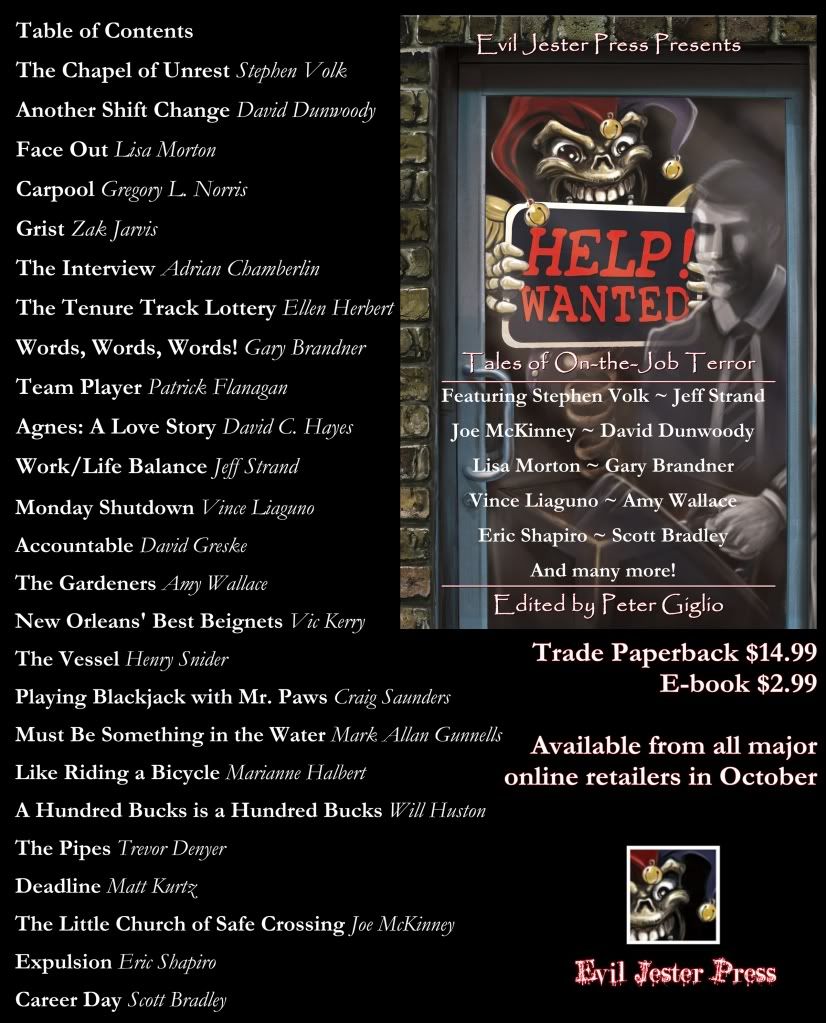
I am thrilled to be part of the forthcoming anthology of corporate evil-themed fiction, HELP! Wanted: Tales of On-the-Job Horror with my short story "Carpool".  The Evil Jester Press collection features some of the genre's heaviest hitters, including the brilliant Stephen Volk (screenwriter of Gothic, one of my all-time favorite films), Vince Liaguno, and Gary Brandner of The Howling fame.  Also among the talent, many of my favorite up-and-coming authors like Craig Saunders, Henry Snider, and Matt Kurtz, all of whom I've had the pleasure of sharing space with between the covers of recent book releases.  Here's the official ToC!


HELP! Wanted  is the brainchild of the amazing Charles Day, EJP's founder, and Senior Editor Peter Giglio, truly two of literature's rising stars (and a couple of great guys with some serious vision).  The anthology weighs in at a very respectable 87,000 words and is scheduled for publication in October 2011.

To view Peter's chilling book trailer, click on: